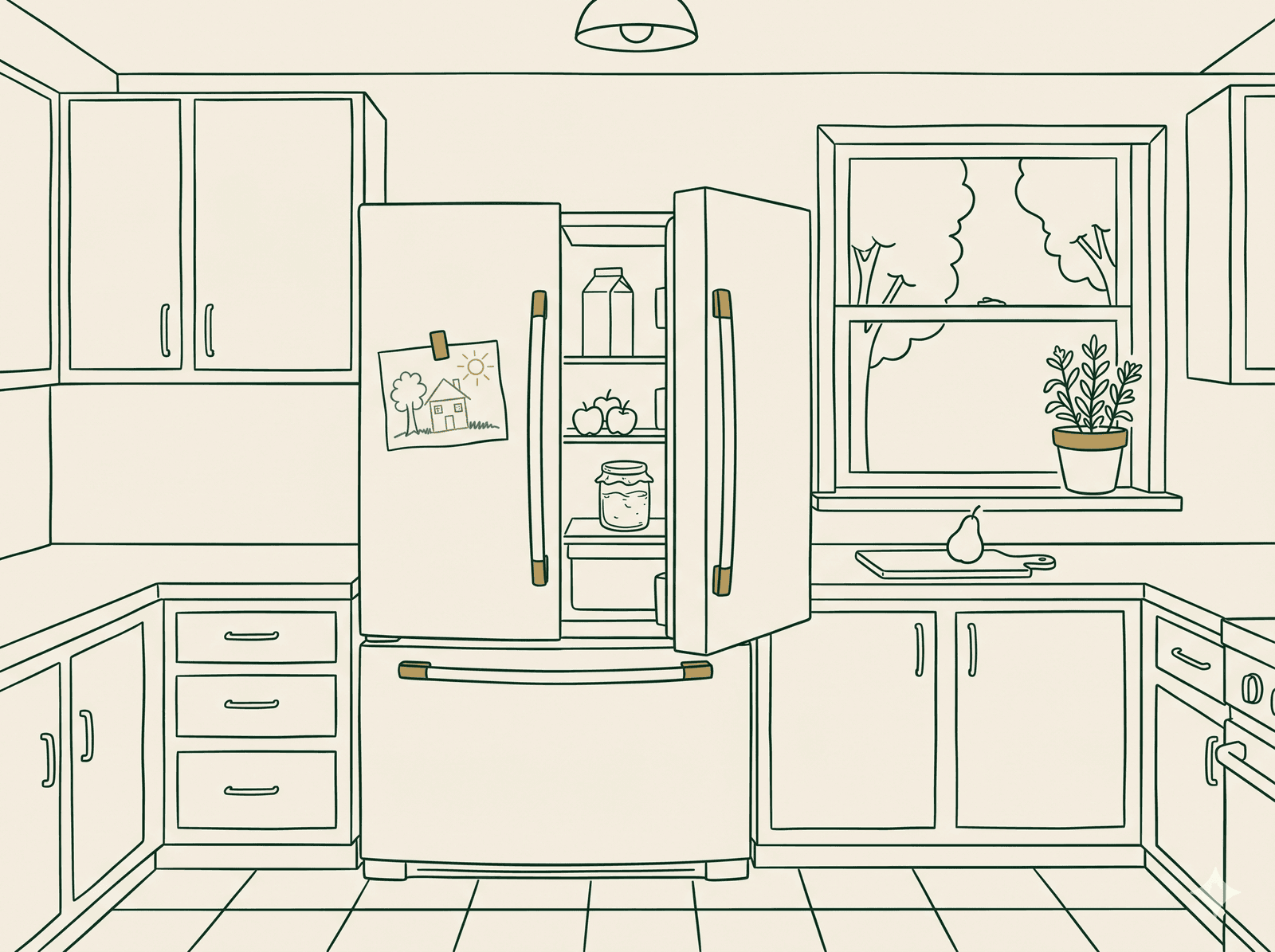
Refrigerators are the appliance most likely to be running every hour of every day — and when one fails, you have a clock running on the food inside. We service every common configuration: side-by-side, French-door, top-freezer, bottom-freezer, counter-depth, and the panel-ready built-in columns common in custom kitchens. Sealed-system work (compressor, refrigerant, evaporator) is regulated and handled by certified technicians; everything else — defrost system, fans, controls — is usually a same-visit fix.
How a fridge works
A fridge moves heat from inside to outside via a sealed loop: a compressor pumps refrigerant through a condenser (where heat is released, usually behind or below the fridge), an evaporator (where heat is absorbed from inside the fridge), and back. A defrost system (heater + thermostat) periodically melts the ice that builds up on the evaporator. When a fridge fails, the symptoms usually point at one of these subsystems.
What we typically fix
- 01
Not cooling
The most common failure. Could be the compressor not running (usually a relay failure rather than the compressor itself), a clogged defrost system (ice buildup on the evaporator blocking airflow), or a failed condenser or evaporator fan. We start with the easy diagnostics — fan operation, listening for compressor — before moving to the harder ones.
- 02
Freezing food in the fresh-food section
Almost always a defrost system issue or a stuck damper. The damper is a small motorized vent between freezer and fridge — when it's stuck open or its sensor reads wrong, freezer-cold air dumps into the fridge section. Less commonly the thermistor (temperature sensor) reads incorrectly.
- 03
Loud compressor or fan
Compressor noise that gets gradually louder over months usually means it's working harder against a partial blockage — could be dirty coils, a failing condenser fan, or early-stage compressor wear. Sudden loud noise is usually the evaporator fan hitting ice buildup. We diagnose by sound location and timing.
- 04
Water leaking onto floor
Three common causes: a clogged defrost drain tube (water from defrost cycle can't drain so it puddles inside, then onto the floor), a failed water inlet valve at the back, or a cracked ice maker line. Watching where the water emerges narrows it down quickly.
- 05
Ice maker not producing
Ice makers fail in several places: the water inlet valve (no water entering), the fill tube freezing solid (no water reaching mold), the ejector motor (ice won't release from mold), or the bin level switch (thinks bin is full). We work through these in order from easiest to hardest.
Types of fridges we service
Different builds fail in different ways. Here's what we see most often across each type.
Side-by-side
Freezer on the left, fridge on the right, both full-height. Mature design with easy parts availability and well-understood failure modes. Ice and water dispenser in the door is the most common service point.
French-door
Two narrow fridge doors on top, freezer drawer underneath. The most popular configuration in current kitchens. More moving parts than side-by-side (more doors, the drawer mechanism) and more sensors (separate temperature zones), so more service points — but each fix is usually straightforward.
Top-freezer / bottom-freezer
The classic two-door layout. Mechanically simpler than side-by-side or French-door. Cheaper parts, faster repairs, more likely to be worth fixing on older units.
Counter-depth and built-in columns
Counter-depth fridges are shallower (24-inch depth instead of 30+) to sit flush with counters. Built-in columns are dedicated full-height fridge or freezer units that mount flush with cabinetry, panel-ready. Both are more complex to remove for service. Common high-end brands: Sub-Zero, Miele, Liebherr.
Signs your fridge needs repair
- Interior temperature creeping above set point
- Food in the fresh section freezing
- Frost building up on the back wall of the freezer
- Compressor running constantly without cycling off
- Water pooling on the floor
- Buzzing or clicking sounds that are new
- Door seal not sticking when you close it
Try these before booking
Quick checks that resolve a meaningful share of fridge calls without a tech visit.
- 01
Check the temperature setting
Especially on French-door models, the temperature controls inside can get bumped accidentally. Confirm both freezer and fridge are at their intended settings.
- 02
Clean the condenser coils
Coils behind or underneath the fridge accumulate dust over years. A dust-clogged coil makes the compressor work harder and can mimic cooling failures. Pull the fridge out, vacuum the coils gently — improves cooling on most fridges with 5+ years of dust.
- 03
Check the door seals
Run a dollar bill around the door gasket. If it pulls out easily anywhere, the seal isn't compressing — fridge is fighting room-temperature air constantly. Sometimes the seal just needs a clean; sometimes it needs replacement.
- 04
Manual defrost if frosted
If frost has built up on the back wall of the freezer, the defrost system has failed. Empty the freezer (transfer to coolers), unplug for 24 hours with door open, place towels to catch melt water. Plug back in — if the issue recurs within a week, the defrost components have failed and need to be replaced.
Parts we can replace
Parts we commonly replace during a fridge repair.
- Compressor relay & overload
- Condenser fan motor
- Evaporator fan motor
- Defrost heater
- Defrost thermostat
- Defrost timer
- Damper assembly
- Door gasket
- Water inlet valve
- Ice maker assembly
- Thermistor
- Control board
- Drain tube
- Door hinges
Before our visit
What to do
- If possible, transfer perishables to a cooler before we arrive
- Move the fridge out a few inches from the wall — we'll need access to the back
- Photograph any error code on the display
- Have the model number ready (inside on a side wall or under a deli drawer)
Finding the model number
Model number is typically inside the fridge — on a side wall above the deli drawer, on the ceiling of the fridge compartment, or behind a kick-panel cover. A photo works.
Safety
Refrigerant systems are regulated under Canadian environmental law — only certified technicians can open the sealed loop (compressor, condenser, evaporator). Confirm at booking whether your visit will need that kind of work. Everything outside the sealed loop — fans, defrost, controls, ice maker — is general appliance work.
Why hire Mendwell for fridge repair
Same-Day Service
Fast turnaround across the GTA. We aim to get your appliance running the same day you call.
Emergency Repair
Fast response for urgent appliance breakdowns. We're here when you need us most.
Warranty on Parts & Labour
Every repair is backed by a warranty on parts and labour. We stand behind the work.
Customer Satisfaction
Your satisfaction is our priority. Personal service on every visit, every time.
Affordable Pricing
Transparent, upfront pricing with no hidden fees. Free estimates before any work starts.
Licensed Technicians
Skilled, licensed technicians ready to handle every repair with care and expertise.
Common questions
Specific to fridge repair.
How long can my food stay safe after the fridge stops cooling?
Do you do sealed-system work (compressor, refrigerant)?
Can you service built-in panel-ready fridges?
How often should the water filter be replaced?
Why is my ice maker making weird-shaped ice?
Should I unplug my fridge while I'm away on vacation?
Why is the back of my fridge warm?
Why is my fridge freezing the food in the fresh section?
Do you replace fridge water filters?
How long should a fridge last?
Worth knowing
How long fridges last
Freestanding fridges last 12–15 years on average; counter-depth and built-in columns often run 18–20+ with proper maintenance. Compressors typically last the longest; defrost components, ice maker assemblies, and electronic controls are the most common parts to fail over the lifespan.
What we don't service
We work on residential and small light-commercial fridges. We don't service walk-in coolers, restaurant-grade cold-storage equipment, or industrial refrigeration.
Where we work
We dispatch fridge technicians across the GTA — often same-day. See all coverage areas →
Other things we repair
Washer
Front-load and top-load washer repair across every major and premium brand. Often same-day across the GTA.
Dryer
Electric and gas dryer repair, including ventless heat-pump models. Often same-day across the GTA.
Freezer
Upright, chest, and integrated freezer repair. We handle defrost system, thermostat, and sealed-system faults.
Dishwasher
Panel-ready, integrated, and freestanding dishwasher repair with proper reinstallation under cabinetry.
Oven
Wall-oven, double-oven, and steam-oven repair. Calibration, igniter replacement, and control board service.
Stove
Slide-in, freestanding, dual-fuel, and pro-style range repair. Gas-line work coordinated with licensed installers.
Cooktop
Induction, radiant, and gas cooktop repair, including high-end integrated models found in custom kitchens.
Microwave
Over-the-range, built-in trim-kit, and drawer microwave repair, including combination convection units.
Range Hood
Wall, island, and insert range hood repair. Motor replacement, fan balancing, and LED lighting service.
Wine Cooler
Dual-zone and single-zone wine refrigerator repair for built-in and freestanding installations.
Ice Maker
Standalone and built-in ice maker repair, including clear-ice and nugget machines.