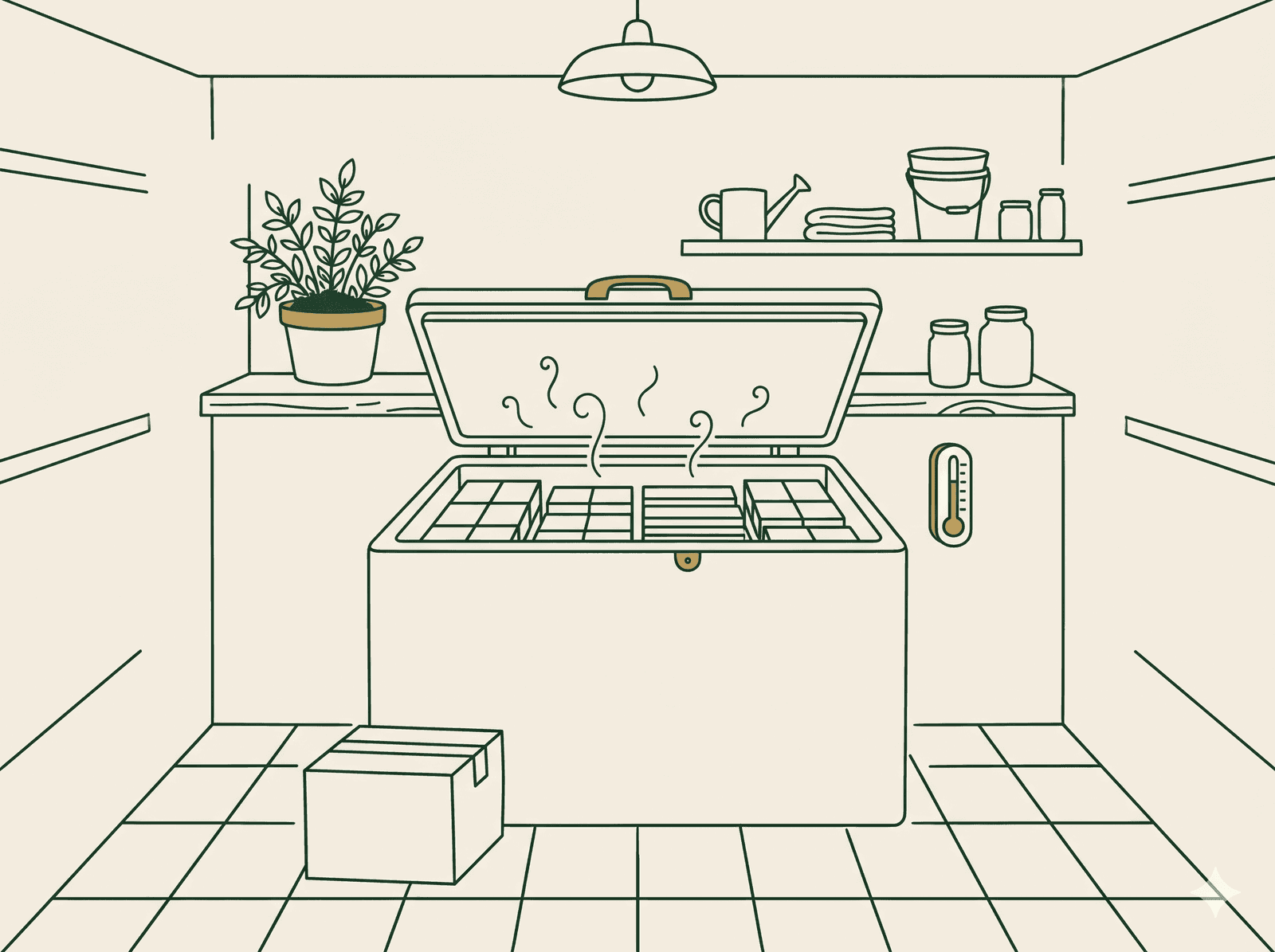
Standalone freezers — upright, chest, and built-in column — fail in different ways than refrigerators despite sharing similar components. The bigger temperature differential (interior is colder than a fridge's freezer compartment) puts more stress on the defrost system and compressor over time. We service every common standalone freezer configuration and the freezer side of integrated fridge-freezer columns.
How a freezer works
Like a refrigerator, a freezer uses a sealed loop of refrigerant — compressor, condenser, evaporator — to pump heat out of the interior. The colder target temperature means the compressor runs more often and longer than a fridge's. Frost-free freezers add a defrost heater and thermostat that periodically melts ice off the evaporator coil; manual-defrost freezers don't, and need to be defrosted by hand annually.
What we typically fix
- 01
Not freezing
Most often a defrost system failure (ice buildup blocks airflow over the evaporator), a failed evaporator fan, or a failed compressor relay. Less commonly the compressor itself or a refrigerant leak. We diagnose by listening to the compressor and checking fan operation first.
- 02
Frost buildup
Frost-free freezers shouldn't have visible frost beyond a light layer. Heavy frost means the defrost system has failed — could be the heater (burned out), the thermostat (not signaling the heater to run), or the defrost timer/control. Sometimes it's just a door seal letting moist air in.
- 03
Temperature swings
Modern freezers should hold within 1–2°C of set point. Wider swings usually mean a failing thermostat or thermistor, a clogged drain tube routing defrost water back over the evaporator, or a door seal letting warm air in.
- 04
Compressor runs constantly
Usually the freezer is fighting to maintain temperature — dirty condenser coils, failing door seal, blocked airflow, or in the worst case a low-refrigerant leak. Sealed-system work is regulated under Canadian environmental law and requires a specific certification.
- 05
Alarm won't silence
Modern freezers have an alarm that triggers when interior temperature rises above set point. If it's persistent, the freezer hasn't recovered temperature even after the door's been closed — usually pointing at a defrost or fan issue.
Types of freezers we service
Different builds fail in different ways. Here's what we see most often across each type.
Upright freezer
Looks like a refrigerator but freezer-only. Easier to organize than chest freezers and easier to access — most upright freezers have shelves or pull-out baskets. Frost-free is the most common type sold today.
Chest freezer
Lid-on-top design, more energy-efficient than upright (cold air doesn't spill out when opened), and typically holds more per cubic foot. Most chest freezers are manual-defrost — you defrost annually by hand.
Integrated freezer column
A standalone full-height freezer designed to mount flush with cabinetry, panel-ready. Common in high-end kitchens. Brands: Sub-Zero, Miele, Liebherr. Pulling for service takes longer than freestanding.
Drawer freezer
Built into bottom of a refrigerator (in French-door fridges) or as a standalone drawer. Smaller capacity but easier-access. Service issues often involve the drawer slides and door seals as much as the cooling system.
Signs your freezer needs repair
- Food in the freezer not fully frozen
- Frost or ice building up on the back wall or coil
- Door not sealing fully when you close it
- Compressor running without ever cycling off
- Loud or new noises from the back of the unit
- Alarm beeping repeatedly
- Water pooling on the floor in front
Try these before booking
Quick checks that resolve a meaningful share of freezer calls without a tech visit.
- 01
Check temperature setting
Confirm the freezer is set to its intended temperature (-18°C / 0°F is standard). Modern controls can get bumped accidentally.
- 02
Clean the condenser coils
Coils on the back or underneath collect dust. Pull the freezer out, vacuum the coils, dust the area. Cleaner coils mean the compressor works less.
- 03
Defrost manually if iced
If you have heavy frost on the back wall, empty the freezer (transfer food to coolers or another freezer), unplug for 24 hours with door open, place towels for the melt water, then plug back in. If frost returns within a week, the defrost system has failed.
- 04
Check the door seal
Dollar-bill test around the gasket — if it slides out easily anywhere, the seal isn't sealing. Sometimes a clean fixes it; sometimes the gasket needs replacement.
Parts we can replace
Parts we commonly replace during a freezer repair.
- Defrost heater
- Defrost timer
- Defrost thermostat
- Evaporator fan
- Condenser fan
- Compressor relay
- Thermostat
- Thermistor
- Door gasket
- Drain tube
- Control board
- Door hinges
- Door switch
Before our visit
What to do
- Transfer food to coolers with ice or another freezer if possible
- Pull the unit out from the wall a few inches
- Photograph any error code or alarm code on the display
- Note when the problem started and what happened around that time
Finding the model number
Model number is typically inside the freezer near the door frame, or on a sticker on the side of the cabinet. A photo works.
Safety
Sealed-system work (compressor, refrigerant) is regulated under Canadian environmental law and requires a specific certification — confirm any technician you hire holds it. Refrigerant leaks are rare but possible — never operate a freezer that smells strongly chemical or whose compressor compartment shows obvious oil residue.
Why hire Mendwell for freezer repair
Same-Day Service
Fast turnaround across the GTA. We aim to get your appliance running the same day you call.
Emergency Repair
Fast response for urgent appliance breakdowns. We're here when you need us most.
Warranty on Parts & Labour
Every repair is backed by a warranty on parts and labour. We stand behind the work.
Customer Satisfaction
Your satisfaction is our priority. Personal service on every visit, every time.
Affordable Pricing
Transparent, upfront pricing with no hidden fees. Free estimates before any work starts.
Licensed Technicians
Skilled, licensed technicians ready to handle every repair with care and expertise.
Common questions
Specific to freezer repair.
How long before food spoils if the freezer stops working?
Are chest freezers more reliable than upright?
Why does my upright freezer keep frosting up?
Can I run my freezer in an unheated garage?
Is my freezer worth repairing?
Why is my freezer running constantly?
Should I unplug my freezer when going on vacation?
What does the alarm on my freezer mean?
Worth knowing
How long freezers last
Standalone freezers typically last 12–16 years. Chest freezers often outlast upright units (simpler design, fewer moving parts). Integrated freezer columns in custom kitchens can run 18–20+ years with maintenance.
What we don't service
We work on residential standalone freezers. We don't service walk-in commercial freezers or industrial refrigeration equipment.
Where we work
We dispatch freezer technicians across the GTA — often same-day. See all coverage areas →
Other things we repair
Washer
Front-load and top-load washer repair across every major and premium brand. Often same-day across the GTA.
Dryer
Electric and gas dryer repair, including ventless heat-pump models. Often same-day across the GTA.
Fridge
Built-in, counter-depth, French-door, and side-by-side refrigerator repair. Sealed-system work performed by certified technicians.
Dishwasher
Panel-ready, integrated, and freestanding dishwasher repair with proper reinstallation under cabinetry.
Oven
Wall-oven, double-oven, and steam-oven repair. Calibration, igniter replacement, and control board service.
Stove
Slide-in, freestanding, dual-fuel, and pro-style range repair. Gas-line work coordinated with licensed installers.
Cooktop
Induction, radiant, and gas cooktop repair, including high-end integrated models found in custom kitchens.
Microwave
Over-the-range, built-in trim-kit, and drawer microwave repair, including combination convection units.
Range Hood
Wall, island, and insert range hood repair. Motor replacement, fan balancing, and LED lighting service.
Wine Cooler
Dual-zone and single-zone wine refrigerator repair for built-in and freestanding installations.
Ice Maker
Standalone and built-in ice maker repair, including clear-ice and nugget machines.