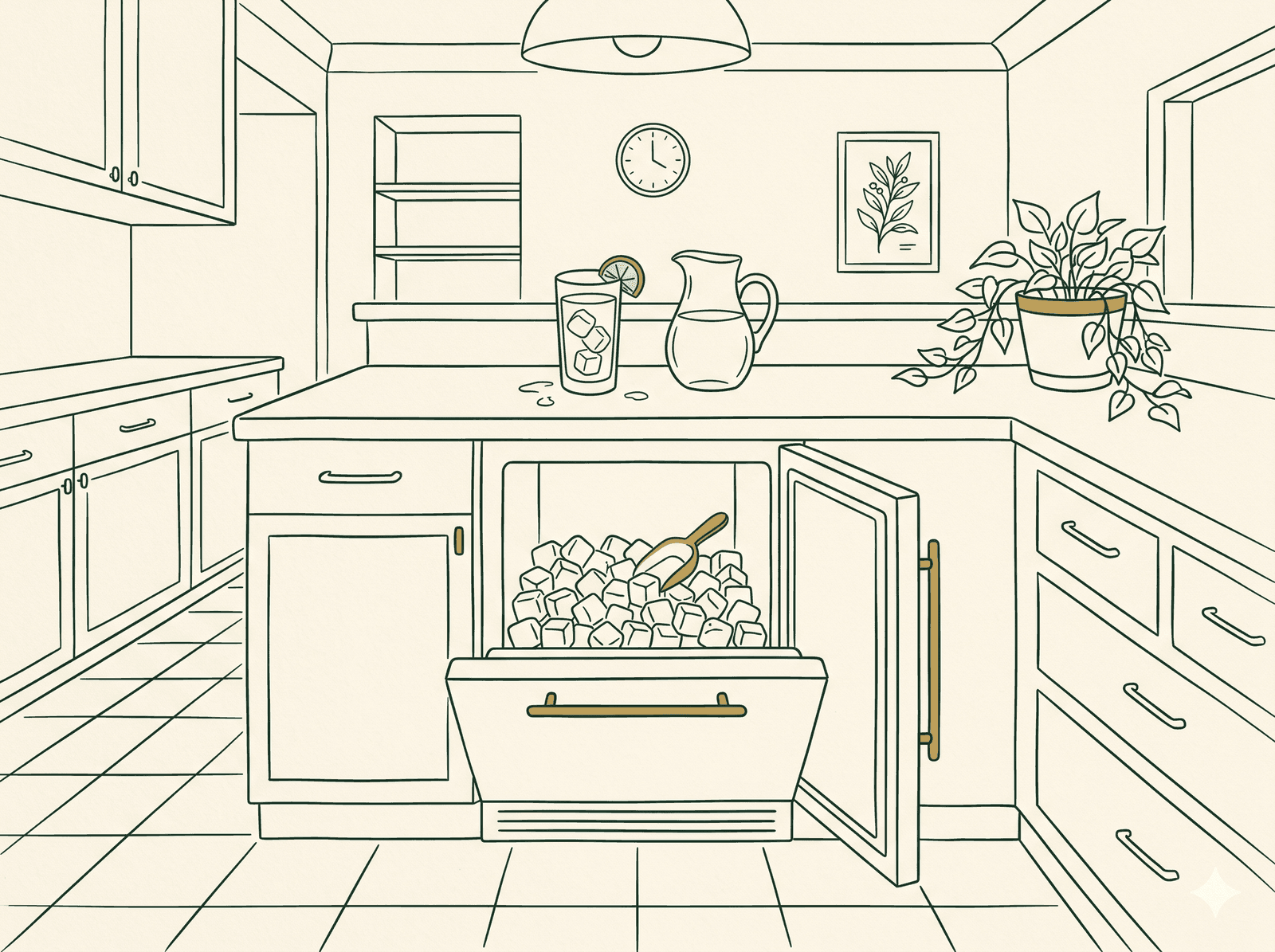
Standalone ice makers and the built-in ice maker assemblies inside refrigerators fail in different ways. Standalone units typically fail at the water pump, the inlet valve, or the ice mold. Refrigerator-integrated ice makers fail more often at the fill valve, the ejector motor, or the ice level switch. We service both and the specialty machines — clear-ice and nugget — that have their own component sets.
How a ice maker works
An ice maker fills a mold with water from a supply line, freezes it (either passively in a refrigerator's freezer, or actively in a standalone unit's evaporator), then ejects the ice into a bin. A level switch detects when the bin is full and pauses production. Each component — fill valve, mold, ejector, bin sensor — is a potential failure point.
What we typically fix
- 01
No ice production
Three common causes: failed water inlet valve (no water entering), frozen fill tube (a clog of ice in the tube where water enters the mold), or failed ice maker motor. We check water flow first.
- 02
Slow ice cycle
Usually water flow restriction — partially clogged inlet valve, aged water filter restricting flow, or low water pressure. Each cycle still completes but produces less ice or smaller cubes.
- 03
Cloudy or off-tasting ice
Mineral content in the water (hard water producing cloudy ice), an aged water filter passing impurities, or biofilm in the water line. Often improved by replacing the filter and running 2–3 batches to flush the system.
- 04
Water leak at intake
The flexible water line behind the fridge or under the ice maker can crack, especially at the connection points. Inlet valve seals can also fail. We tighten or replace whichever has failed.
- 05
Pump failure (standalone)
Standalone ice makers use a small water pump to circulate water over the evaporator during freezing. When the pump fails, the unit either stops making ice or produces incomplete ice. Routine replacement.
- 06
Bin sensor errors
The level switch tells the ice maker when the bin is full. When it sticks or fails, the unit either keeps producing (overflowing the bin) or stops thinking it's full (no ice production).
Types of ice makers we service
Different builds fail in different ways. Here's what we see most often across each type.
Refrigerator-integrated
Built into the freezer or fridge of a regular refrigerator. The most common type. Failures are usually in the inlet valve or the ice maker assembly itself; the assembly is often a single replaceable drop-in unit.
Standalone under-counter
Built-in unit installed under a counter, with its own water connection and drain. Common in entertainment areas and home bars. More components than fridge-integrated since it has its own cooling system.
Clear-ice machine
Produces fully transparent ice (no air bubbles) by circulating water over the evaporator during freezing — bubbles escape as the ice forms. Common in higher-end bars and kitchens. More complex than standard ice makers.
Nugget ice machine
Produces soft, chewable nugget ice (the kind from drive-thru fountain drinks). Different mechanism — produces ice slabs that are then ground. Hospitality-grade equipment that's also sold for residential use.
Signs your ice maker needs repair
- Ice level dropping but not refilling
- Cubes coming out smaller, cloudy, or oddly shaped
- Water pooling near the back of the fridge or under a standalone unit
- Ice tasting strange or off
- Ice maker cycling but no ice in the bin
- Ice clumping into a single mass
Try these before booking
Quick checks that resolve a meaningful share of ice maker calls without a tech visit.
- 01
Check the water line
Behind the fridge, look at the flexible water line connecting to the rear of the unit. Check for kinks, signs of leaks, or where the line exits the wall.
- 02
Replace the water filter
Water filters that go too long restrict flow and let impurities through. Most manufacturers recommend replacement every 6 months. Filter replacement often fixes 'small/cloudy/slow' ice issues.
- 03
Confirm the ice maker is turned on
Sounds basic, but most ice makers have a wire bail arm or a toggle switch that turns off ice production. Verify it's in the 'on' position.
- 04
Reset by power cycling
Some ice makers (especially in newer refrigerators) reset by unplugging the fridge for 5 minutes and plugging back in. Clears stuck control board states.
Parts we can replace
Parts we commonly replace during a ice maker repair.
- Water inlet valve
- Water pump (standalone)
- Evaporator (standalone)
- Ice mold
- Ice level switch
- Control board
- Ice maker assembly (drop-in)
- Water filter housing
- Drain pump
- Ejector motor
Before our visit
What to do
- Clear the ice bin
- Check the date on your water filter — if it's overdue, replace it before our visit
- Photograph any error code or behaviour
- Locate the water shutoff under the sink or behind the unit
Finding the model number
For refrigerator-integrated ice makers, the fridge's model number is what matters (inside the fridge cabinet). For standalone units, the model number is on a sticker inside the cabinet or on the back.
Why hire Mendwell for ice maker repair
Same-Day Service
Fast turnaround across the GTA. We aim to get your appliance running the same day you call.
Emergency Repair
Fast response for urgent appliance breakdowns. We're here when you need us most.
Warranty on Parts & Labour
Every repair is backed by a warranty on parts and labour. We stand behind the work.
Customer Satisfaction
Your satisfaction is our priority. Personal service on every visit, every time.
Affordable Pricing
Transparent, upfront pricing with no hidden fees. Free estimates before any work starts.
Licensed Technicians
Skilled, licensed technicians ready to handle every repair with care and expertise.
Common questions
Specific to ice maker repair.
Why is my ice coming out cloudy?
How often should I replace the water filter?
Why is my ice maker producing less ice than it used to?
Can you fix my standalone ice maker that's leaking?
My ice tastes weird. What's wrong?
How long should an ice maker last?
Why is my ice clumping into one big mass?
Do you service nugget ice machines?
Worth knowing
How long ice makers last
Refrigerator-integrated ice makers typically last as long as the fridge (12–15 years). Standalone under-counter ice makers run 8–12 years. Nugget ice machines run 6–10 years (more complex mechanism).
What we don't service
We work on residential ice makers. We don't service commercial high-volume ice machines or industrial ice plants.
Where we work
We dispatch ice maker technicians across the GTA — often same-day. See all coverage areas →
Other things we repair
Washer
Front-load and top-load washer repair across every major and premium brand. Often same-day across the GTA.
Dryer
Electric and gas dryer repair, including ventless heat-pump models. Often same-day across the GTA.
Fridge
Built-in, counter-depth, French-door, and side-by-side refrigerator repair. Sealed-system work performed by certified technicians.
Freezer
Upright, chest, and integrated freezer repair. We handle defrost system, thermostat, and sealed-system faults.
Dishwasher
Panel-ready, integrated, and freestanding dishwasher repair with proper reinstallation under cabinetry.
Oven
Wall-oven, double-oven, and steam-oven repair. Calibration, igniter replacement, and control board service.
Stove
Slide-in, freestanding, dual-fuel, and pro-style range repair. Gas-line work coordinated with licensed installers.
Cooktop
Induction, radiant, and gas cooktop repair, including high-end integrated models found in custom kitchens.
Microwave
Over-the-range, built-in trim-kit, and drawer microwave repair, including combination convection units.
Range Hood
Wall, island, and insert range hood repair. Motor replacement, fan balancing, and LED lighting service.
Wine Cooler
Dual-zone and single-zone wine refrigerator repair for built-in and freestanding installations.