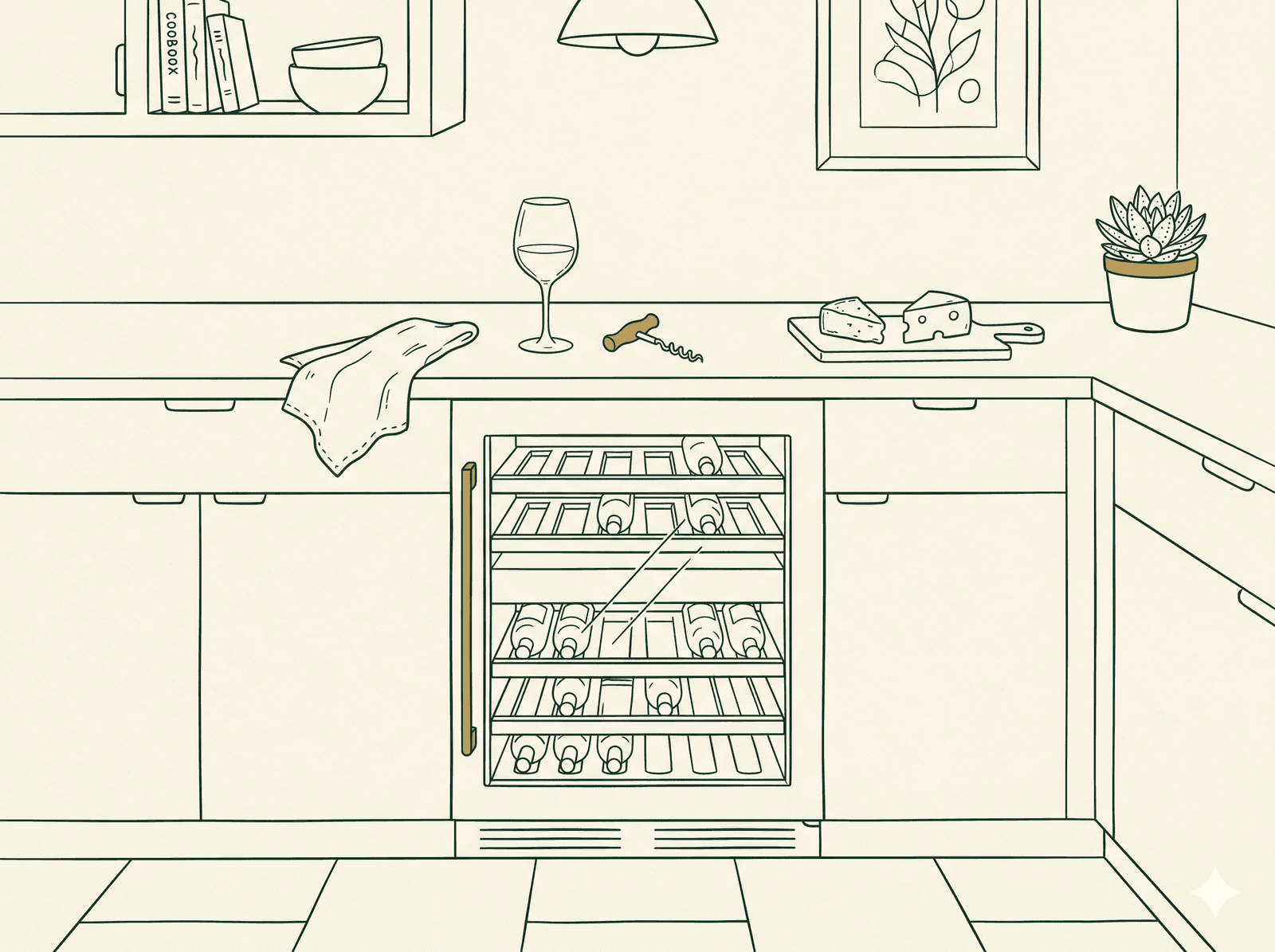
Dual-zone and single-zone wine refrigerators fail differently from regular fridges despite shared components. Temperature drift, single-zone outage, and vibration complaints — which actually matter for wine — are the usual reasons we're called. Built-in wine columns common in custom kitchens need careful pulling for access; we handle that without damaging cabinetry.
How a wine cooler works
A wine cooler uses either thermoelectric cooling (Peltier-effect, no moving parts, lower performance) or compressor cooling (same technology as a regular fridge, more reliable, better at maintaining stable temperatures). Dual-zone units have two independent cooling sections — typically a cooler zone for reds and a warmer zone for whites. Each zone has its own temperature sensor and either its own compressor or a shared compressor with a damper system.
What we typically fix
- 01
Temperature drift
The interior temperature drifts away from set point over hours or days. Most often a failing thermistor (temperature sensor reading wrong), a clogged condenser coil (compressor working harder), or a door seal letting in ambient air. Wine is sensitive to temperature stability, so this matters more than in a regular fridge.
- 02
One zone not cooling (dual-zone)
Common failure mode in dual-zone units. Could be a failed damper that controls airflow between zones, a failed second compressor (in two-compressor models), or a thermistor specific to the failed zone.
- 03
Fan noise
Wine coolers have at least one fan to circulate air over the cooling coils. When the fan bearings wear, you get a hum or rattle that's especially noticeable since wine coolers are typically in living spaces rather than kitchens. Fan motor replacement is routine.
- 04
Door seal or hinge wear
Wine cooler doors get opened less often than fridges but the gasket still ages and hardens. A worn gasket lets ambient air in, forcing the cooler to work harder. Hinges sometimes loosen over time, causing the door to droop and not seal.
- 05
Display fault
Touch panels and LED displays on wine coolers fail from age, sometimes from condensation in humid environments. Replacement is straightforward.
- 06
Compressor failure
The most expensive failure mode. Compressors on wine coolers usually last 8–12 years; signal failures include the compressor never cycling on, running constantly without cooling, or making unusual noises. Sealed-system work is regulated.
Types of wine coolers we service
Different builds fail in different ways. Here's what we see most often across each type.
Freestanding (single or dual-zone)
Standalone units that can sit on a floor or counter. Easier to pull for service than built-ins. Cooling is typically compressor-based for serious storage, thermoelectric for budget units.
Built-in / undercounter
Designed to install flush with cabinetry. Common in entertainment areas and bars. Venting is forward through a kick plate, so they can be installed without ventilation gaps around the cabinet.
Built-in column
Full-height wine refrigerators designed to mount flush with cabinetry. Common in dedicated wine rooms or as part of custom kitchens. Brands: Sub-Zero, Liebherr, Miele.
Dual-zone (vs single-zone)
Dual-zone units have two independent temperature compartments — typically warmer for whites, cooler for reds. More complex internally, more service points, but more flexible for mixed collections.
Signs your wine cooler needs repair
- Temperature reading drifting from set point
- One zone warmer or cooler than set in dual-zone units
- Bottles closer to the door noticeably warmer than those at the back
- Audible vibration that wasn't there before
- Condensation inside the cabinet
- Door not closing or sealing fully
Try these before booking
Quick checks that resolve a meaningful share of wine cooler calls without a tech visit.
- 01
Check the level
Wine coolers should be level both side-to-side and front-to-back. Off-level coolers vibrate more and can damage the compressor over time. Use a small bubble level on top.
- 02
Confirm door seal
Run a dollar bill around the door seal — if it pulls out easily anywhere, the seal isn't compressing. Sometimes a clean of the gasket fixes it.
- 03
Check the condenser coil
Coils on the back or underneath collect dust over years. Vacuum gently. Dust-clogged coils make the compressor work harder and shorten its life.
- 04
Verify ambient temperature
Most wine coolers are rated for ambient temperatures between 18°C and 30°C. In garages or unheated rooms outside that range, the cooler may struggle.
Parts we can replace
Parts we commonly replace during a wine cooler repair.
- Thermistor
- Fan motor
- Compressor relay
- Control board
- Door gasket
- Door hinges
- Damper assembly
- Display panel
- Condenser fan
- LED interior lights
Before our visit
What to do
- Transfer wine to similar-temperature storage if possible
- Pull the unit out from the wall a few inches for access
- Photograph any error code on the display
- Have the model number ready
Finding the model number
Model number is typically inside the cabinet on a side wall or on the back of the unit.
Safety
Sealed-system work is regulated under Canadian environmental law and requires a specific certification — confirm any technician you hire holds it.
Why hire Mendwell for wine cooler repair
Same-Day Service
Fast turnaround across the GTA. We aim to get your appliance running the same day you call.
Emergency Repair
Fast response for urgent appliance breakdowns. We're here when you need us most.
Warranty on Parts & Labour
Every repair is backed by a warranty on parts and labour. We stand behind the work.
Customer Satisfaction
Your satisfaction is our priority. Personal service on every visit, every time.
Affordable Pricing
Transparent, upfront pricing with no hidden fees. Free estimates before any work starts.
Licensed Technicians
Skilled, licensed technicians ready to handle every repair with care and expertise.
Common questions
Specific to wine cooler repair.
Why does the temperature in my wine cooler keep drifting?
Is vibration in my wine cooler hurting my wine?
What's the ideal temperature for my wine cooler?
Why is my dual-zone not maintaining different temperatures between zones?
Can you service my Sub-Zero wine column?
How long should a wine cooler last?
Should I store my wine cooler in the garage?
Why is there condensation on my wine cooler?
Worth knowing
How long wine coolers last
10–15 years for compressor-based wine coolers; 6–10 for thermoelectric. Premium built-in columns (Sub-Zero, Miele) often last 18–22+ years with maintenance.
What we don't service
We work on residential wine coolers. We don't service commercial cellar systems or temperature-controlled rooms.
Where we work
We dispatch wine cooler technicians across the GTA — often same-day. See all coverage areas →
Other things we repair
Washer
Front-load and top-load washer repair across every major and premium brand. Often same-day across the GTA.
Dryer
Electric and gas dryer repair, including ventless heat-pump models. Often same-day across the GTA.
Fridge
Built-in, counter-depth, French-door, and side-by-side refrigerator repair. Sealed-system work performed by certified technicians.
Freezer
Upright, chest, and integrated freezer repair. We handle defrost system, thermostat, and sealed-system faults.
Dishwasher
Panel-ready, integrated, and freestanding dishwasher repair with proper reinstallation under cabinetry.
Oven
Wall-oven, double-oven, and steam-oven repair. Calibration, igniter replacement, and control board service.
Stove
Slide-in, freestanding, dual-fuel, and pro-style range repair. Gas-line work coordinated with licensed installers.
Cooktop
Induction, radiant, and gas cooktop repair, including high-end integrated models found in custom kitchens.
Microwave
Over-the-range, built-in trim-kit, and drawer microwave repair, including combination convection units.
Range Hood
Wall, island, and insert range hood repair. Motor replacement, fan balancing, and LED lighting service.
Ice Maker
Standalone and built-in ice maker repair, including clear-ice and nugget machines.