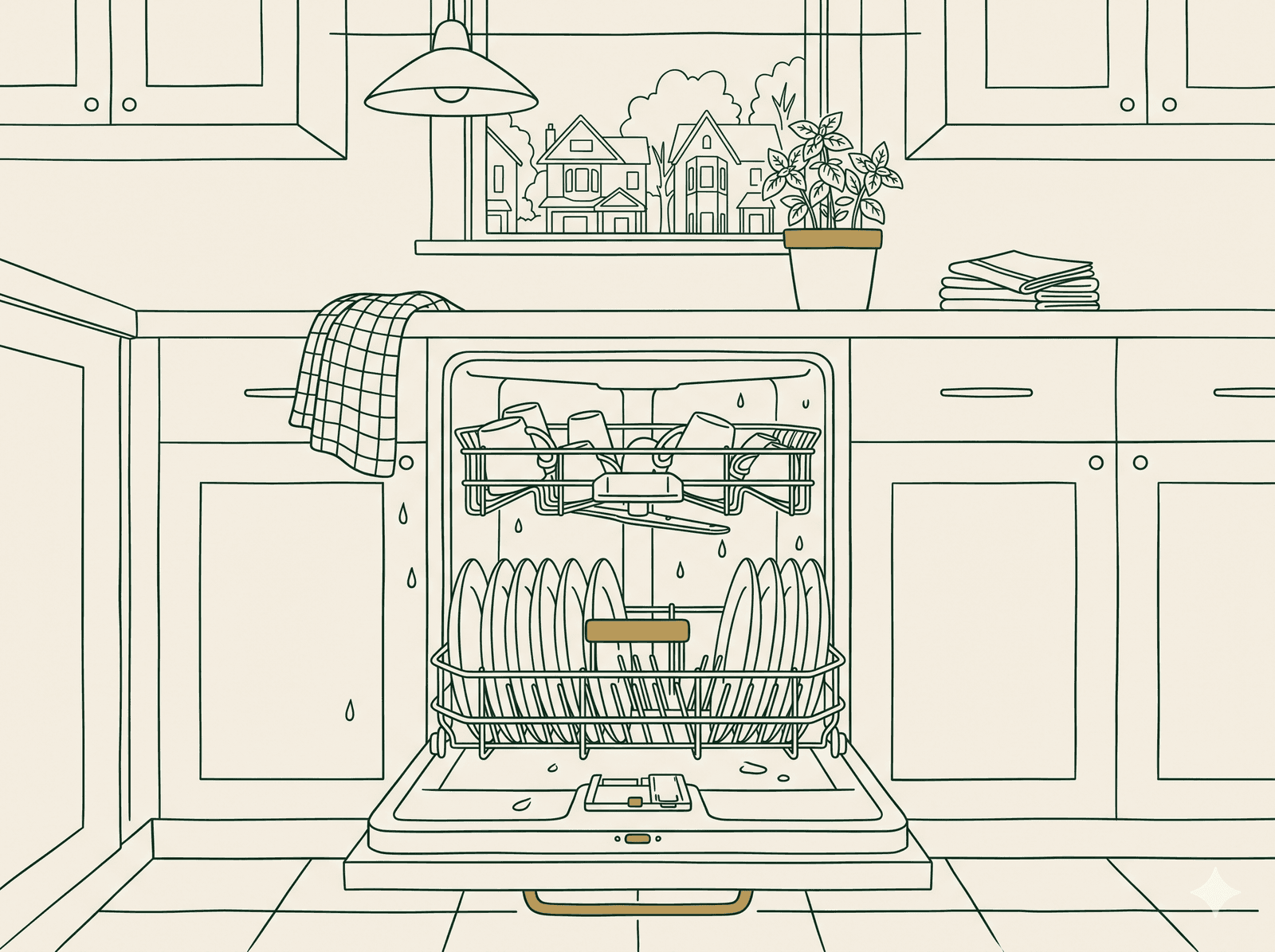
Dishwashers fail in one of four areas: drainage, water supply, heating, or door/latch. Built-in and panel-ready dishwashers — common in most kitchens — need careful removal and reinstallation under cabinetry, which we handle without scratching surrounding finishes. Most fixes are completed during the visit; control boards are the one part that sometimes needs to be ordered.
How a dishwasher works
A dishwasher fills with hot water through an inlet valve, sprays it through rotating spray arms while a heating element keeps the water hot, then drains it through a pump and out a hose. Each cycle adds detergent at a specific point via a dispenser. Most failures point at one of these subsystems — fill, wash (spray + heat), or drain.
What we typically fix
- 01
Not draining
The most common dishwasher failure. Usually a clogged drain pump (food debris caught around the impeller), a clogged drain hose, or the air gap on the counter (if present). Less commonly a failed pump motor. We start with the filter and work toward the pump.
- 02
Leaving dishes wet or dirty
Could be a low water heater temperature (incoming water not hot enough — try running hot water at the sink before starting the cycle), a clogged spray arm, a failed heating element (no dry cycle heat), or a worn door seal. Different symptoms point at different causes.
- 03
Leaking onto floor
Several possibilities — failed door gasket, cracked tub (rare but serious), loose hose connection at the inlet valve, or a worn pump seal. Most common in older machines is the door gasket. We watch where the water emerges to narrow it down quickly.
- 04
Won't start mid-cycle
Usually the door latch — if the dishwasher can't confirm the door is fully closed, it pauses or won't start. Less commonly a failed control board or a tripped thermal fuse (which trips if heating element overheats from running dry).
- 05
Soap dispenser not opening
The dispenser is a small mechanical door that opens at a specific point in the cycle. The release mechanism can stick (especially if you don't fully rinse residue from the dispenser), or the wax motor that triggers it can fail.
Types of dishwashers we service
Different builds fail in different ways. Here's what we see most often across each type.
Built-in 24-inch
The standard residential dishwasher, installed under cabinetry with a stainless or panel-ready front. Most failures we see are in this category. Removal for service requires careful disconnection from water, drain, and power, then careful reinstallation without scratching surrounding cabinetry.
Panel-ready integrated
Same internal mechanism as a standard built-in, but designed to accept a custom cabinet panel matching the rest of the kitchen. Common in custom kitchens. Service is identical except the panel removal step — we handle these carefully.
Compact 18-inch
Narrow dishwashers common in apartments, condos, and small kitchens. Same components scaled down. Parts are sometimes more specialty, but service is otherwise the same.
Drawer dishwasher
Single- or double-drawer designs where each drawer is its own dishwasher. Common in high-end kitchens and pull-out designs. Each drawer has its own pump and motor; failures usually affect only one drawer at a time.
Signs your dishwasher needs repair
- Standing water in the bottom after the cycle finishes
- Dishes coming out spotted, wet, or with food still on them
- Water visible under the dishwasher or on the floor in front
- Cycle pauses or stops partway through
- Soap dispenser door not opening
- Burning smell during operation
- Error codes on the display
Try these before booking
Quick checks that resolve a meaningful share of dishwasher calls without a tech visit.
- 01
Clean the filter
Most dishwashers have a removable cylindrical filter at the bottom of the tub. Pull it out, rinse under hot water (use a soft brush if greasy), and put it back. This solves a meaningful share of 'not draining' and 'dishes not clean' calls.
- 02
Run hot water at the sink first
The dishwasher's inlet valve doesn't have its own heater — it uses the household hot water. Running hot water at the sink for 30 seconds before starting the cycle ensures the dishwasher fills with actually-hot water.
- 03
Check the spray arms
Pull the spray arms out (they usually pop off). Hold them up to light to see if any of the small holes are clogged. Clean with a toothpick or rinse. Reinstall and run an empty cycle.
- 04
Confirm the door is fully closed
Some dishwashers have a sensitive door latch — if the latch doesn't fully engage, the dishwasher won't start or will pause. Try slamming the door (gently) until you hear the latch click firmly.
Parts we can replace
Parts we commonly replace during a dishwasher repair.
- Drain pump
- Water inlet valve
- Door latch assembly
- Door gasket
- Heating element
- Spray arms
- Float switch
- Soap dispenser
- Control board
- Pump motor
- Drain hose
- Wax motor
- Door hinges
- Rack rollers
Before our visit
What to do
- Clear all dishes from the dishwasher
- Locate the water supply valve under the sink — we may need to shut it off
- Photograph any error code on the display
- If possible, run a hot cycle at the sink right before we arrive
Finding the model number
Model number is on the inside of the door frame — either the top edge that's only visible when the door is open, or on the side of the door frame. A photo works.
Why hire Mendwell for dishwasher repair
Same-Day Service
Fast turnaround across the GTA. We aim to get your appliance running the same day you call.
Emergency Repair
Fast response for urgent appliance breakdowns. We're here when you need us most.
Warranty on Parts & Labour
Every repair is backed by a warranty on parts and labour. We stand behind the work.
Customer Satisfaction
Your satisfaction is our priority. Personal service on every visit, every time.
Affordable Pricing
Transparent, upfront pricing with no hidden fees. Free estimates before any work starts.
Licensed Technicians
Skilled, licensed technicians ready to handle every repair with care and expertise.
Common questions
Specific to dishwasher repair.
Why is my dishwasher not draining?
Why are my dishes coming out wet?
Can you service my panel-ready dishwasher without damaging the panel?
Why is there standing water at the bottom of the tub between cycles?
Why does my dishwasher smell bad?
Should I hand-rinse dishes before loading?
Why does my dishwasher take 2+ hours per cycle?
How long should a dishwasher last?
Is hard water damaging my dishwasher?
Do you service Miele, Bosch, KitchenAid, and other premium dishwasher brands?
Worth knowing
How long dishwashers last
9–12 years for standard residential dishwashers. Premium European brands (Miele, Bosch) often last 12–15 years with maintenance. The most common life-ending failure is the control board on electronic models; on older mechanical models, the drain pump is most common.
What we don't service
We work on residential dishwashers. We don't service commercial conveyor or rack dishwashers or restaurant-grade equipment.
Where we work
We dispatch dishwasher technicians across the GTA — often same-day. See all coverage areas →
Other things we repair
Washer
Front-load and top-load washer repair across every major and premium brand. Often same-day across the GTA.
Dryer
Electric and gas dryer repair, including ventless heat-pump models. Often same-day across the GTA.
Fridge
Built-in, counter-depth, French-door, and side-by-side refrigerator repair. Sealed-system work performed by certified technicians.
Freezer
Upright, chest, and integrated freezer repair. We handle defrost system, thermostat, and sealed-system faults.
Oven
Wall-oven, double-oven, and steam-oven repair. Calibration, igniter replacement, and control board service.
Stove
Slide-in, freestanding, dual-fuel, and pro-style range repair. Gas-line work coordinated with licensed installers.
Cooktop
Induction, radiant, and gas cooktop repair, including high-end integrated models found in custom kitchens.
Microwave
Over-the-range, built-in trim-kit, and drawer microwave repair, including combination convection units.
Range Hood
Wall, island, and insert range hood repair. Motor replacement, fan balancing, and LED lighting service.
Wine Cooler
Dual-zone and single-zone wine refrigerator repair for built-in and freestanding installations.
Ice Maker
Standalone and built-in ice maker repair, including clear-ice and nugget machines.